


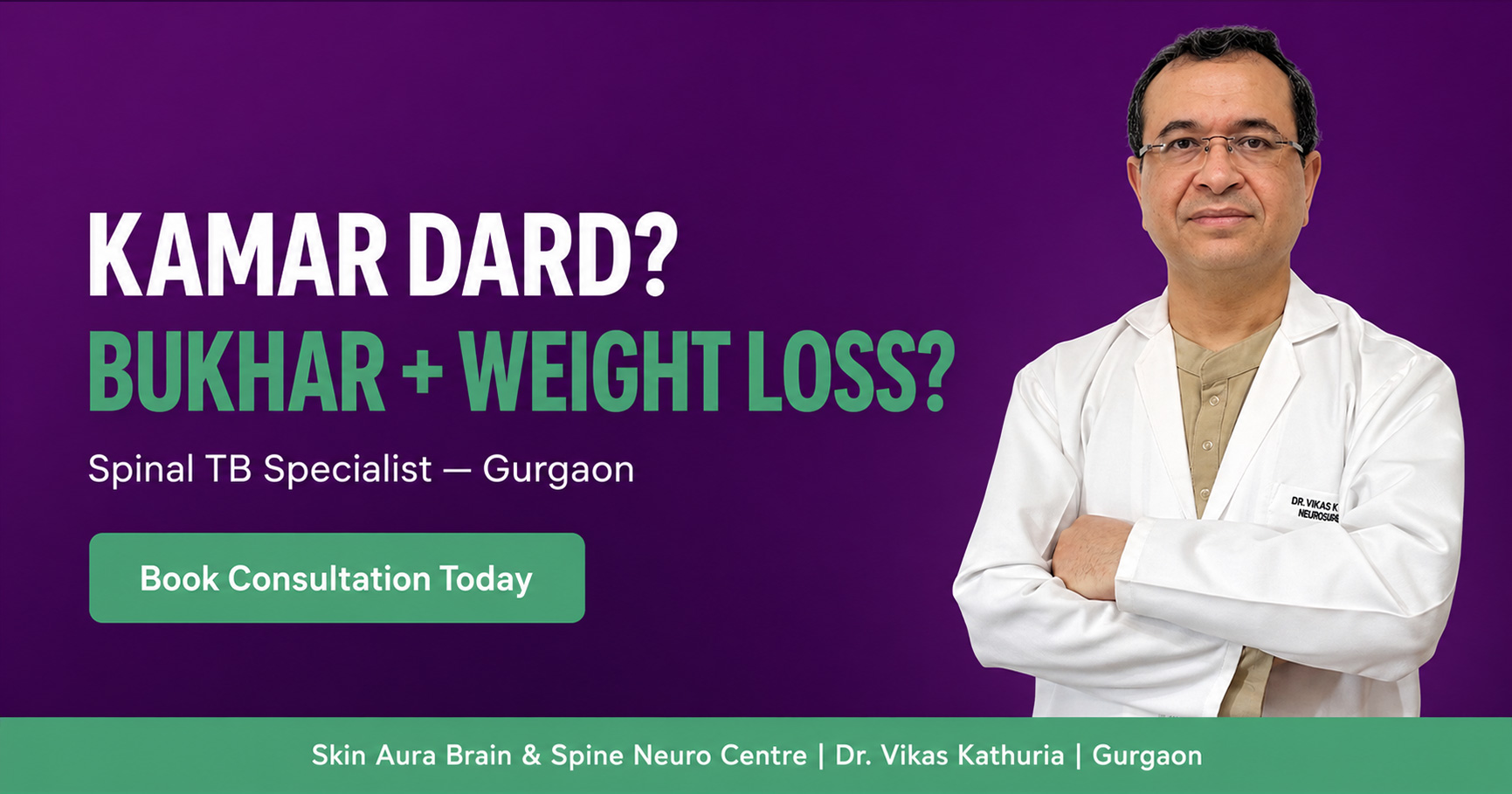
Spinal tuberculosis treatment in Gurgaon – diagnosis, surgery & recovery
Tuberculosis remains one of India’s most significant public health challenges — and while most people associate TB with the lungs, spinal tuberculosis is the most common form of skeletal TB and one of the most serious. Also known as Pott’s disease — named after the 18th century surgeon Percivall Pott who first described it — spinal TB can cause progressive vertebral destruction, spinal deformity, and devastating neurological complications including paralysis if not diagnosed and treated promptly.
At Skin Aura Brain & Spine Neuro Centre Gurgaon, Dr. Vikas Kathuria diagnoses and manages spinal tuberculosis across all stages of severity — from early disease presenting with back pain and fever to advanced cases with vertebral collapse, abscess formation, and neurological deficits requiring surgical intervention.
What is spinal tuberculosis?
Spinal tuberculosis is an infection of the vertebral column caused by Mycobacterium tuberculosis — the same bacterium responsible for pulmonary TB. The infection reaches the spine through the bloodstream from a primary focus elsewhere in the body — most commonly the lungs — even when the primary lung infection was subclinical and never diagnosed. The bacteria seed into the vertebral bodies where they cause progressive inflammatory destruction of bone, intervertebral discs, and surrounding soft tissues.
The lower thoracic and upper lumbar vertebrae — the thoracolumbar junction — are the most commonly affected region, though cervical and lumbar spine involvement also occurs. As the vertebrae are destroyed, they collapse and compress against each other — producing the characteristic angular kyphotic deformity (gibbus deformity) of advanced spinal TB. Pus and infected material collect as paraspinal and psoas abscesses — sometimes tracking far from the original vertebral site.
Who is at risk for spinal tuberculosis in Gurgaon?
Spinal TB affects people across all socioeconomic groups in the NCR region. Risk factors include previous TB infection anywhere in the body, close contact with active TB patients, immunosuppression from HIV, diabetes, malnutrition, or immunosuppressive medication, and living or working in overcrowded environments. The large daily commuter and migrant worker population in Gurgaon’s construction and service sectors represents a population with higher TB exposure risk. Any patient presenting with persistent back pain, weight loss, and low-grade fever should be evaluated for spinal TB at Skin Aura Brain & Spine Neuro Centre Gurgaon regardless of socioeconomic background.
Symptoms of spinal tuberculosis
Spinal tuberculosis characteristically presents insidiously — symptoms develop slowly over weeks to months, which is one reason diagnosis is frequently delayed. Back pain is the most universal symptom — persistent, progressive, and often worse at rest and at night — distinguishing it from mechanical back pain that typically improves with rest. Constitutional symptoms including low-grade fever, night sweats, unexplained weight loss, and fatigue are present in many but not all patients. A visible or palpable angular deformity (gibbus) over the spine may be present in patients with significant vertebral collapse. Neurological symptoms — leg weakness, numbness, bladder or bowel dysfunction — indicate spinal cord or nerve root compression from collapsed vertebrae, abscess, or inflammatory tissue pressing on neural structures. This is the most serious presentation and requires urgent neurosurgical evaluation at Skin Aura Brain & Spine Neuro Centre Gurgaon.
How is spinal tuberculosis diagnosed in Gurgaon?
Dr. Vikas Kathuria conducts a thorough clinical assessment including a detailed history of TB exposure and constitutional symptoms. MRI of the spine is the most sensitive imaging investigation for spinal TB — it demonstrates vertebral body involvement, disc destruction, paraspinal and epidural abscess, and spinal cord compression with exceptional clarity before plain X-ray changes become apparent. CT scan provides detailed assessment of bone destruction and surgical planning. Chest X-ray and CT chest identify concurrent pulmonary TB. Blood investigations include ESR, CRP, and TB-specific tests including the Mantoux test and IGRA (interferon-gamma release assay). CT-guided biopsy of the affected vertebra provides microbiological and histopathological confirmation of the diagnosis — essential for antibiotic sensitivity testing — and is performed at Skin Aura Brain & Spine Neuro Centre Gurgaon when imaging findings are not entirely classical.
Non-surgical treatment for spinal tuberculosis in Gurgaon
The foundation of spinal TB treatment is a prolonged course of anti-tuberculosis therapy (ATT) — a combination of four drugs (isoniazid, rifampicin, ethambutol, and pyrazinamide) for the initial two months followed by two drugs (isoniazid and rifampicin) for a further 10–16 months. The total treatment duration for spinal TB is typically 12–18 months.
Most patients with spinal TB — including those with early to moderate vertebral involvement and mild neurological deficits — respond well to medical treatment alone. Pain improves over weeks, constitutional symptoms resolve, and vertebral healing progresses gradually over months of ATT. A spinal brace or orthosis is recommended for patients with significant vertebral instability to reduce pain and prevent further deformity during treatment at Skin Aura Brain & Spine Neuro Centre Gurgaon.
When is surgery needed for spinal tuberculosis in Gurgaon?
Surgery is required in spinal TB when significant neurological deficit is present — weakness, numbness, or bladder and bowel dysfunction caused by spinal cord or nerve root compression from abscess or collapsed vertebrae, neurological deterioration despite adequate anti-tuberculosis therapy, large paraspinal or psoas abscess requiring surgical drainage, severe spinal instability or deformity causing pain and progressive neurological risk, failed medical management with disease progression, and need for tissue biopsy when diagnosis cannot be confirmed by less invasive means.
Surgical treatment for spinal tuberculosis at Skin Aura Brain & Spine Neuro Centre Gurgaon
Debridement and decompression
Debridement and decompression involves surgical removal of infected bone, disc, and abscess material compressing the spinal cord or nerve roots — directly relieving neurological compression and removing the infected focus. This is the most urgently required procedure when significant neurological deficit is present.
Spinal reconstruction and fusion
Spinal reconstruction and fusion — When significant vertebral destruction has produced spinal instability or deformity, reconstruction using bone graft and instrumentation (titanium implants) restores spinal alignment and stability while decompressing neural structures. This may be performed through anterior (front), posterior (back), or combined approaches depending on the location and extent of disease.
Abscess drainage
Abscess drainage — Large paraspinal or psoas abscesses that do not resolve with ATT are drained surgically or percutaneously under CT guidance to reduce bacterial load, relieve pain, and accelerate treatment response.
About Dr. Vikas Kathuria – spinal tuberculosis specialist at Skin Aura Brain & Spine Neuro Centre Gurgaon
Managing spinal tuberculosis requires a neurosurgeon with comprehensive spinal surgical expertise — the ability to decompress the spinal cord, reconstruct destroyed vertebrae, and manage the technical challenges posed by infected, friable bone and tissue planes distorted by abscess and inflammation. Dr. Vikas Kathuria’s M.Ch. Neurosurgery qualification, 14+ years of spinal surgical experience, and NSSA membership equip him to manage spinal TB across the full spectrum of severity at Skin Aura Brain & Spine Neuro Centre Gurgaon — from medical management of early disease to complex surgical reconstruction for advanced deformity with neurological deficit.
Before and after spinal tuberculosis treatment
Patients treated promptly for spinal TB with appropriate ATT and timely surgical intervention when required consistently achieve excellent outcomes at Skin Aura Brain & Spine Neuro Centre Gurgaon. Pain resolves progressively over the first weeks to months of ATT. Neurological deficits — particularly those of relatively short duration before surgery — recover significantly following decompression, with many patients regaining full walking ability and bladder function. Constitutional symptoms — fever, night sweats, and weight loss — resolve within the first 4–8 weeks of effective ATT. Long-term spinal stability is maintained by appropriate fusion when required, and vertebral healing is confirmed on follow-up imaging at 6 and 12 months.
Frequently asked questions
Is spinal tuberculosis curable in Gurgaon?
Yes — spinal tuberculosis is curable with the right combination of anti-tuberculosis therapy and surgical treatment when required. Early diagnosis and complete treatment compliance are the most important factors determining outcome.
How long does spinal TB treatment take?
Anti-tuberculosis therapy for spinal TB lasts 12–18 months. Neurological recovery after surgery continues for 6–18 months depending on the severity and duration of nerve compression before treatment. Regular follow-up at Skin Aura Brain & Spine Neuro Centre Gurgaon monitors response throughout.
Can spinal TB cause permanent paralysis?
If left untreated or diagnosed very late, severe spinal cord compression from spinal TB can cause permanent paralysis. This is why any patient with back pain, constitutional symptoms, and neurological deficits should seek urgent evaluation at Skin Aura Brain & Spine Neuro Centre Gurgaon without delay.
Is spinal TB contagious?
Spinal TB itself is not directly contagious through the spine. However if there is concurrent active pulmonary TB, appropriate respiratory precautions are required. Contact tracing and screening of close contacts is recommended for all TB patients.
Does surgery for spinal TB leave a permanent implant?
Titanium implants used for spinal reconstruction in TB are biocompatible and safe — they do not need to be removed once spinal fusion is complete. They provide permanent structural stability to the reconstructed spine.
Consult Dr. Vikas Kathuria for spinal tuberculosis treatment at Skin Aura Brain & Spine Neuro Centre Gurgaon
If you are experiencing persistent back pain with constitutional symptoms — or have been diagnosed with spinal TB and need specialist neurosurgical evaluation — book a consultation with Dr. Vikas Kathuria, M.Ch. Neurosurgery at Skin Aura Brain & Spine Neuro Centre Gurgaon today. Early, accurate diagnosis and the right treatment plan make all the difference. Serving patients from DLF, Golf Course Road, South Delhi, Faridabad, Rewari, and across NCR.