


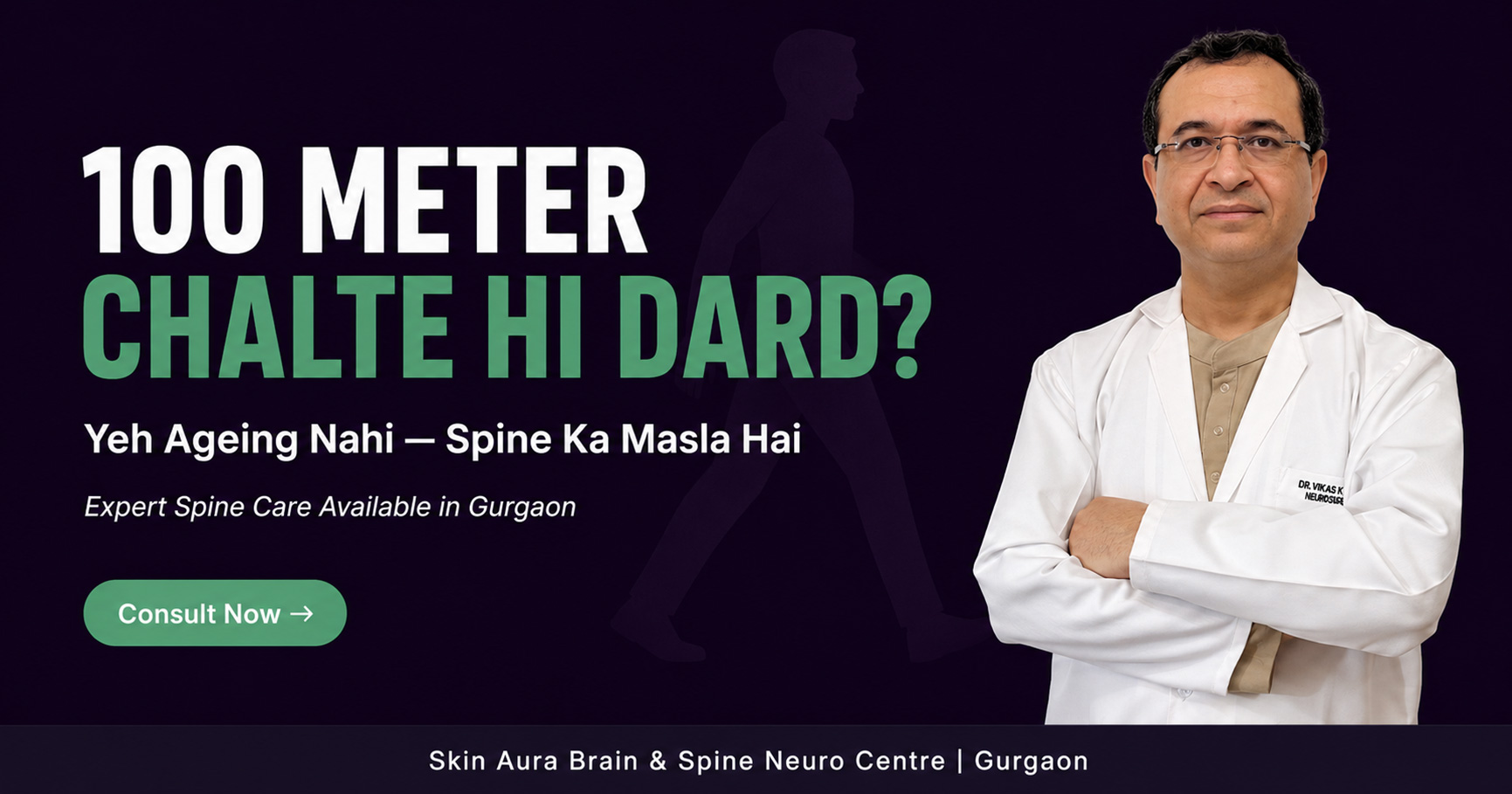
Lumbar canal stenosis treatment in Gurgaon – symptoms, causes & surgical options
If you are experiencing leg pain, heaviness, or weakness that appears when you walk and is relieved by sitting or bending forward — and these symptoms are progressively limiting how far you can walk — you may be suffering from lumbar canal stenosis. It is one of the most common spinal conditions affecting adults above 50 in Gurgaon, and one that is frequently misdiagnosed as peripheral vascular disease, hip arthritis, or simple ageing.
At Skin Aura Brain & Spine Neuro Centre Gurgaon, Dr. Vikas Kathuria sees lumbar canal stenosis patients from across Gurgaon, DLF, South Delhi, and Faridabad — many of whom have been living with progressive walking limitation for years without an accurate diagnosis or an effective treatment plan. This comprehensive guide explains everything about the condition and how it is treated.
What is lumbar canal stenosis?
The spinal canal is the bony tunnel running through the centre of the vertebral column through which the spinal cord and the cauda equina — the bundle of nerve roots supplying the legs and bladder — travel. Lumbar canal stenosis is the narrowing of this spinal canal in the lower back region, caused by the cumulative degenerative changes that occur in the spine with ageing.
As the intervertebral discs lose height and bulge outward, as bone spurs (osteophytes) form on the vertebral edges and facet joints, as the ligamentum flavum — the yellow ligament lining the back of the spinal canal — thickens and folds inward, the available space for the nerve roots progressively diminishes. When this narrowing becomes sufficiently severe, the nerve roots are compressed — particularly during walking and standing upright, when the spinal canal naturally narrows further.
The hallmark symptom: neurogenic claudication
The characteristic symptom of lumbar canal stenosis is neurogenic claudication — a term describing the leg pain, heaviness, cramping, numbness, or weakness that develops after walking a certain distance and is relieved by sitting down, leaning forward on a shopping trolley, or bending the spine forward.
This pattern of symptoms — walking distance limited, relieved by rest in a flexed position — is highly specific to lumbar canal stenosis and distinguishes it from vascular claudication (caused by arterial disease) where the legs ache with walking but are not relieved by forward bending.
Patients at Skin Aura Brain & Spine Neuro Centre Gurgaon typically describe being able to walk only 100–200 metres before needing to stop and rest, noticing that cycling or pushing a shopping trolley (both involve a forward-flexed spine) causes far less discomfort than walking upright, experiencing bilateral leg symptoms — both legs affected — though often asymmetrically, and having associated lower back pain, though notably the leg symptoms are often more disabling than the back pain itself.
In advanced cases, constant numbness or weakness in the legs, difficulty climbing stairs, and urinary urgency or frequency may also be present — indicating significant cauda equina compression requiring prompt evaluation at Skin Aura Brain & Spine Neuro Centre Gurgaon.
How is lumbar canal stenosis diagnosed in Gurgaon?
Dr. Vikas Kathuria begins with a detailed clinical history focusing on the walking limitation pattern and a neurological examination assessing leg strength, reflexes, and sensation. MRI of the lumbar spine is the definitive diagnostic investigation — it clearly demonstrates the degree of canal narrowing, the levels involved, and the specific structures causing compression (disc, osteophyte, thickened ligament, or a combination). CT myelography may be used in specific cases. Standing X-rays assess spinal alignment and any associated spondylolisthesis.
Non-surgical treatment for lumbar canal stenosis in Gurgaon
For mild to moderate lumbar canal stenosis without significant neurological deficit, Dr. Kathuria at Skin Aura Brain & Spine Neuro Centre Gurgaon begins with conservative management. This includes a structured physiotherapy programme focused on flexion-based lumbar exercises, core strengthening, and postural correction, anti-inflammatory and analgesic medications for pain management, epidural steroid injections delivering anti-inflammatory medication directly around the compressed nerve roots — providing significant but typically temporary symptomatic relief, and lifestyle modification including activity pacing and avoiding prolonged standing and walking on steep inclines.
Many patients achieve meaningful symptomatic improvement with conservative management. However lumbar canal stenosis is a structural, progressive condition — the underlying narrowing does not resolve with physiotherapy or injections, and most patients with moderate to severe stenosis eventually require surgical decompression for durable relief.
Surgical treatment for lumbar canal stenosis at Skin Aura Brain & Spine Neuro Centre Gurgaon
Laminectomy and decompression
Laminectomy and decompression is the standard surgical treatment for lumbar canal stenosis. Dr. Vikas Kathuria removes the lamina — the bony arch forming the back wall of the spinal canal — along with the thickened ligamentum flavum and any osteophytes contributing to nerve compression. This directly enlarges the spinal canal, relieving the pressure on the compressed nerve roots. The procedure is performed under general anaesthesia using microsurgical magnification for precise tissue identification and nerve protection. Hospital stay is typically 3–5 days. Most patients notice improvement in their walking distance and leg symptoms beginning within days to weeks of surgery.
Laminectomy with spinal fusion
Laminectomy with spinal fusion is recommended when significant spinal instability accompanies the stenosis — particularly in cases of degenerative spondylolisthesis where one vertebra has slipped forward over another. Adding fusion to the decompression prevents post-operative instability and the recurrence of symptoms that can occur when stenosis coexists with significant vertebral slipping. Dr. Kathuria discusses the need for fusion versus decompression alone at the pre-operative consultation based on each patient’s specific imaging findings and clinical presentation at Skin Aura Brain & Spine Neuro Centre Gurgaon.
Minimally invasive decompression
Minimally invasive decompression — where appropriate, Dr. Kathuria performs lumbar decompression through smaller incisions using tubular retractors and microsurgical technique — reducing muscle disruption, blood loss, and post-operative pain while achieving the same decompressive result as open surgery.
About Dr. Vikas Kathuria – lumbar canal stenosis specialist at Skin Aura Brain & Spine Neuro Centre Gurgaon
Dr. Kathuria’s M.Ch. Neurosurgery, 14+ years of dedicated spinal surgical experience, and membership in the Neuro Spinal Surgeons Association (NSSA) make him one of Gurgaon’s most experienced specialists for lumbar canal stenosis. His conservative-first philosophy ensures patients receive appropriate non-surgical management when safe — and timely surgical intervention when the clinical picture demands it. Patients from across Gurgaon, DLF, Golf Course Road, South Delhi, and Faridabad consult Dr. Kathuria at Skin Aura Brain & Spine Neuro Centre Gurgaon for expert evaluation and management of this common but debilitating condition.
Before and after lumbar canal stenosis treatment
Patients who undergo successful laminectomy for lumbar canal stenosis at Skin Aura Brain & Spine Neuro Centre Gurgaon consistently report a dramatic improvement in walking ability — from being limited to 100–200 metres before surgery to walking comfortably for kilometres post-operatively. The leg heaviness, cramping, and numbness that characterised every outing resolves progressively over weeks following nerve decompression. For many elderly patients, successful stenosis surgery represents a complete restoration of independence — the ability to shop, socialise, and participate in family life without the walking limitation that had progressively isolated them.
Frequently asked questions
Is lumbar canal stenosis dangerous if left untreated in Gurgaon?
Lumbar canal stenosis is not immediately life-threatening but is progressively disabling. Without treatment, walking distance typically decreases progressively over years. Cauda equina syndrome — sudden loss of bladder, bowel, and leg function from acute severe compression — is a rare but serious complication requiring emergency surgery.
Can lumbar canal stenosis be treated without surgery?
Mild to moderate stenosis can often be managed effectively with physiotherapy and epidural injections for significant periods. Surgery is recommended when symptoms are severe, progressive neurological deficit is present, or conservative treatment has failed to maintain adequate quality of life.
What is the recovery time after laminectomy for lumbar canal stenosis in Gurgaon?
Most patients are mobilised and walking with assistance the day after surgery. Hospital stay is 3–5 days. Return to light activities occurs within 4–6 weeks. Physiotherapy begins shortly after surgery and continues for 3–4 months to maximise functional recovery.
Is lumbar canal stenosis surgery safe for elderly patients?
Yes — with appropriate pre-operative medical assessment. Lumbar decompression is routinely and safely performed in patients in their 70s and 80s at Skin Aura Brain & Spine Neuro Centre Gurgaon. The functional benefit of restored walking ability in elderly patients is profound and significantly improves overall health and quality of life.
What is the difference between lumbar canal stenosis and a slipped disc?
A slipped disc (herniated disc) typically causes sudden, severe leg pain (sciatica) in younger patients from acute nerve root compression by disc material. Lumbar canal stenosis develops gradually in older patients from multiple degenerative changes narrowing the entire canal — producing the characteristic walking limitation of neurogenic claudication rather than acute sciatica.
Consult Dr. Vikas Kathuria for lumbar canal stenosis treatment at Skin Aura Brain & Spine Neuro Centre Gurgaon
If walking has become progressively more difficult and leg pain or heaviness is limiting your independence, do not accept this as inevitable ageing. Book a consultation with Dr. Vikas Kathuria, M.Ch. Neurosurgery, at Skin Aura Brain & Spine Neuro Centre Gurgaon today. Serving patients from DLF, Golf Course Road, South Delhi, Faridabad, Rewari, and across NCR.