


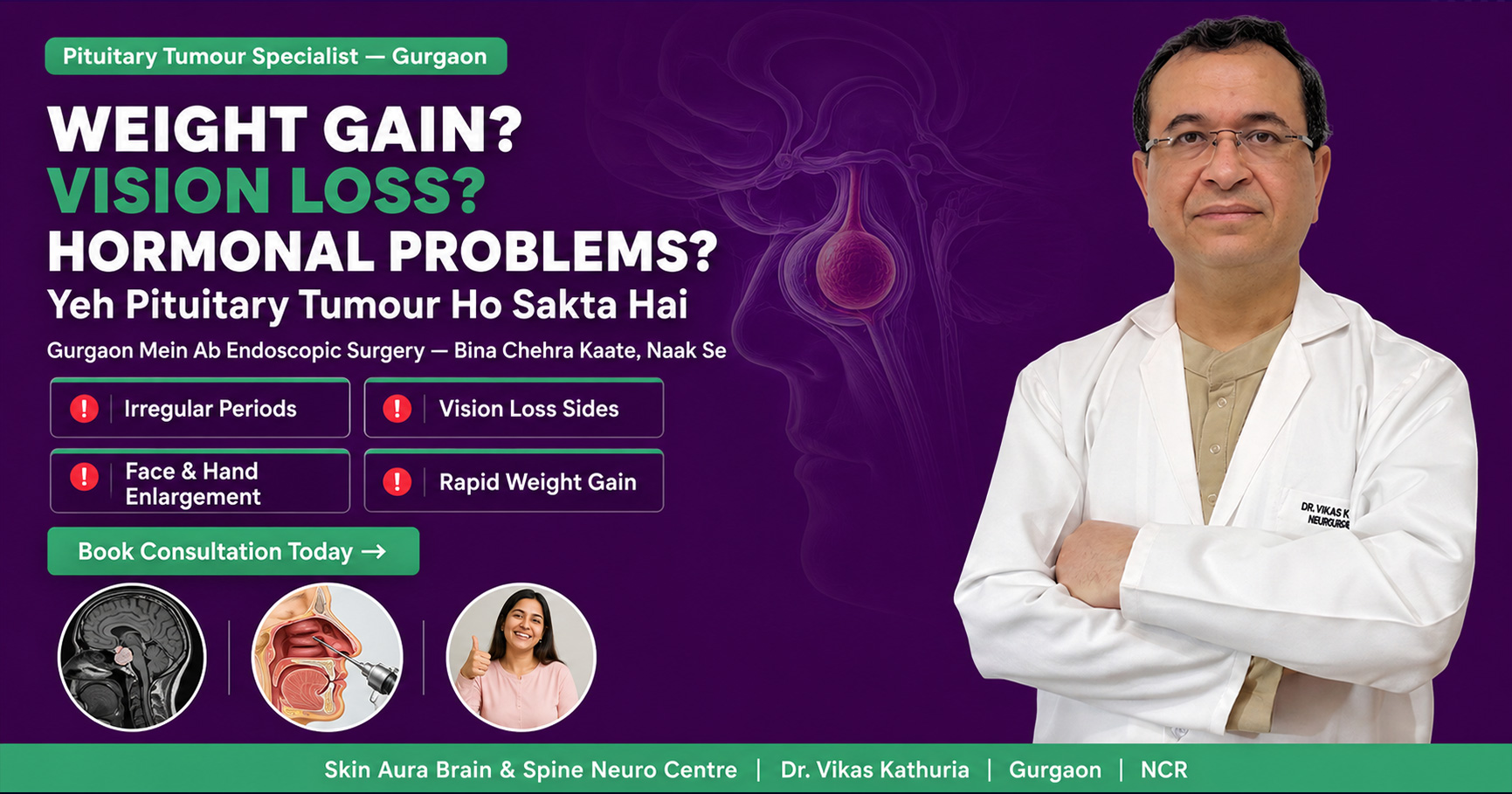
Pituitary Tumour Surgery in Gurgaon – A Complete Patient Guide
The pituitary gland is one of the smallest and most powerful organs in the human body — a pea-sized structure at the base of the brain that controls growth, metabolism, reproduction, stress response, and virtually every major hormonal system in the body. When a tumour develops in or around the pituitary gland, the consequences extend far beyond the brain itself — causing hormonal imbalances, vision problems, and neurological symptoms that affect every aspect of a patient’s daily life.
If you or a family member has been diagnosed with a pituitary tumour and is looking for expert neurosurgical care in Gurgaon, this comprehensive guide from Dr. Vikas Kathuria at Skin Aura Brain & Spine Neuro Centre Gurgaon explains everything you need to know — what pituitary tumours are, how they present, how they are treated, and what recovery looks like.
What is a pituitary tumour?
A pituitary tumour — also called a pituitary adenoma — is an abnormal growth of cells within the pituitary gland. The vast majority of pituitary tumours are benign (non-cancerous) and grow slowly. However, even benign pituitary tumours can cause serious problems because of their location and their impact on hormone production and the surrounding structures — particularly the optic nerves that carry vision from the eyes to the brain.
Pituitary tumours are classified in two ways. By size — microadenomas are less than 1cm in diameter while macroadenomas are 1cm or larger. And by function — functioning tumours produce excess hormones and cause specific hormonal syndromes, while non-functioning tumours do not produce hormones but cause problems through their size and pressure on surrounding structures.
Types of pituitary tumours and their symptoms
Prolactinomas
Prolactinomas are the most common functioning pituitary tumour. They produce excess prolactin — the hormone responsible for breast milk production. In women they cause irregular or absent periods, unexplained milk production from the breasts, infertility, and reduced sex drive. In men they cause reduced libido, erectile dysfunction, infertility, and breast tissue enlargement.
Growth hormone secreting tumours
Growth hormone secreting tumours cause acromegaly in adults — a condition characterised by abnormal enlargement of the hands, feet, and facial features, thickening of the skin, joint pain, excessive sweating, and increased risk of diabetes and cardiovascular disease. In children, excess growth hormone causes gigantism — abnormally rapid growth in height.
ACTH secreting tumours
ACTH secreting tumours cause Cushing’s disease — excess cortisol production resulting in central weight gain (particularly around the abdomen and face — the classic moon face and buffalo hump), easy bruising, thin skin, stretch marks, high blood pressure, diabetes, and severe psychological changes including depression.
TSH secreting tumours
TSH secreting tumours stimulate excess thyroid hormone production causing hyperthyroidism — weight loss, palpitations, tremors, anxiety, and heat intolerance.
Non-functioning macroadenomas
Non-functioning macroadenomas do not produce hormones but grow large enough to compress the normal pituitary gland — causing panhypopituitarism (deficiency of multiple pituitary hormones) — and to press on the optic chiasm, the crossing point of the optic nerves that sits directly above the pituitary gland. This compression causes the characteristic bitemporal hemianopia — loss of the outer visual fields of both eyes — that is the classic visual symptom of a large pituitary tumour. Headache from pressure within the enclosed pituitary space is also common.
How is a pituitary tumour diagnosed in Gurgaon?
Diagnosis begins with a thorough clinical assessment of symptoms by Dr. Vikas Kathuria at Skin Aura Brain & Spine Neuro Centre Gurgaon. Blood and urine hormone levels are measured to identify any excess or deficiency of pituitary hormones. A dedicated pituitary MRI — using thin-slice, high-resolution sequences specifically designed to visualise the pituitary gland — confirms the presence, size, and location of the tumour. Formal visual field testing is performed when optic chiasm compression is suspected. These investigations together allow accurate classification of the tumour and guide the most appropriate treatment approach.
Treatment options for pituitary tumours at Skin Aura Brain & Spine Neuro Centre Gurgaon
Medical treatment
Medical treatment is the first-line therapy for prolactinomas — dopamine agonist medications such as cabergoline or bromocriptine effectively shrink prolactinomas and normalise prolactin levels in the majority of patients, often without requiring surgery. For acromegaly and Cushing’s disease, medical therapy is used as an adjunct to surgery or for patients who are not surgical candidates.
Endoscopic transsphenoidal surgery
Endoscopic transsphenoidal surgery is the primary surgical treatment for most pituitary tumours. This is where Dr. Vikas Kathuria’s specialist neuroendoscopy training at Skin Aura Brain & Spine Neuro Centre Gurgaon delivers a critical advantage. In endoscopic transsphenoidal surgery, the pituitary tumour is removed entirely through the nose — without any incision on the face or skull. A rigid endoscope is passed through the nostril and nasal cavity, through the sphenoid sinus, and directly to the pituitary gland at the skull base. The tumour is then carefully removed under endoscopic visualisation using specialised instruments.
This approach offers several significant advantages over older microscopic transsphenoidal surgery — wider panoramic visualisation of the surgical field, better illumination of tumour edges and surrounding critical structures, ability to look around corners to identify tumour remnants, and superior outcomes for complete tumour removal. There are no external scars, no brain retraction, and no craniotomy. Hospital stay is typically 3–5 days and most patients return to normal activities within 2–3 weeks.
Open craniotomy
Open craniotomy is occasionally required for large tumours with significant extension above the pituitary fossa that cannot be safely reached through the transsphenoidal approach. This is used selectively for complex cases.
Radiotherapy
Radiotherapy — including stereotactic radiosurgery (Gamma Knife or CyberKnife) — is used for residual tumour after surgery, recurrent tumours, or in patients who are not surgical candidates. It is a precisely focused radiation technique that delivers high doses to the tumour while sparing surrounding structures.
About Dr. Vikas Kathuria – pituitary tumour specialist at Skin Aura Brain & Spine Neuro Centre Gurgaon
Dr. Vikas Kathuria’s Neuroendoscopy Fellowship from NSCB Govt. Medical College, Jabalpur — combined with his M.Ch. Neurosurgery from V.S. Hospital, Smt. NHL Medical College, Ahmedabad and 14+ years of neurosurgical experience — makes him one of the very few neurosurgeons in Gurgaon specifically trained in the endoscopic skull base and transsphenoidal approach for pituitary tumours. His membership in the Neurological Society of India (NSI) ensures his practice reflects the most current evidence in pituitary neurosurgery. Patients from DLF, Golf Course Road, South Delhi, Faridabad, and across NCR access this subspecialty expertise at Skin Aura Brain & Spine Neuro Centre Gurgaon.
Recovery after pituitary tumour surgery
Most patients undergoing endoscopic transsphenoidal surgery at Skin Aura Brain & Spine Neuro Centre Gurgaon are transferred to a monitored ward after surgery and remain in hospital for 3–5 days. Nasal packing is not routinely required with modern endoscopic techniques — making the post-operative period significantly more comfortable than older approaches. Mild nasal congestion and headache in the first 1–2 weeks are normal and managed with simple analgesia.
Hormone levels are reassessed at 6 weeks post-operatively to confirm normalisation or to plan any required hormone replacement therapy. Vision typically begins improving within days of surgery when optic chiasm compression is successfully relieved. MRI follow-up at 3 months confirms the extent of tumour removal and guides further management planning.
Before and after pituitary tumour treatment
Patients treated for functioning pituitary tumours — particularly Cushing’s disease and acromegaly — describe some of the most transformative treatment outcomes in all of neurosurgery. The reversal of the physical changes of Cushing’s — weight redistribution, skin improvement, blood pressure normalisation — and the regression of acromegaly features over months following successful surgery represents a profound restoration of health that patients describe as life-changing. Vision improvement following relief of optic chiasm compression is often immediate and dramatic — patients who had been losing peripheral vision progressively for months experience recovery beginning within the first post-operative days.
Frequently asked questions
Is pituitary tumour surgery dangerous in Gurgaon?
Endoscopic transsphenoidal surgery for pituitary tumours is one of the safer neurosurgical procedures when performed by a trained endoscopic skull base surgeon. The approach avoids the brain entirely — working through the nose — dramatically reducing neurological risks compared to open craniotomy. Dr. Kathuria’s dedicated neuroendoscopy training at Skin Aura Brain & Spine Neuro Centre Gurgaon ensures the highest standard of endoscopic pituitary surgical care.
Can a pituitary tumour be treated without surgery in Gurgaon?
Yes — in certain cases. Prolactinomas respond excellently to medical therapy with dopamine agonists and often do not require surgery. Other functioning and non-functioning tumours typically require surgical treatment when they are growing, causing visual loss, or producing significant hormonal excess not controlled by medication.
How long does endoscopic pituitary surgery take?
Most endoscopic transsphenoidal procedures take 2–4 hours depending on tumour size, consistency, and degree of extension. Dr. Kathuria discusses the expected procedure duration at the pre-operative consultation at Skin Aura Brain & Spine Neuro Centre Gurgaon.
Will I need hormone replacement after pituitary surgery?
This depends on whether the normal pituitary gland was functioning adequately before surgery and how much function is preserved afterward. Some patients require temporary or permanent hormone replacement — assessed comprehensively by an endocrinologist working in collaboration with Dr. Kathuria at Skin Aura Brain & Spine Neuro Centre Gurgaon.
Can a pituitary tumour come back after surgery?
Recurrence is possible — particularly for larger tumours where complete removal was not achievable. Regular MRI follow-up and hormone monitoring at Skin Aura Brain & Spine Neuro Centre Gurgaon detects any recurrence early, allowing timely additional treatment before significant regrowth occurs.
Consult Dr. Vikas Kathuria for pituitary tumour treatment at Skin Aura Brain & Spine Neuro Centre Gurgaon
If you have been diagnosed with a pituitary tumour — or are experiencing symptoms that suggest a pituitary disorder — book a consultation with Dr. Vikas Kathuria at Skin Aura Brain & Spine Neuro Centre Gurgaon today. Expert endoscopic neurosurgical care, comprehensive hormone assessment, and personalised treatment planning for patients from DLF, Golf Course Road, South Delhi, Faridabad, and across NCR.