


Emergency Head Injury Treatment in Gurgaon – A Complete Patient Guide
Head injuries are one of the leading causes of death and permanent disability in India – and Gurgaon’s busy roads, rapid construction activity, and dense traffic make them a distressingly frequent occurrence across the NCR region. A head injury can range from a minor concussion requiring observation to a life-threatening traumatic brain injury requiring emergency neurosurgery within minutes. Understanding the difference – and knowing when and where to seek immediate specialist care – is information that could save a life.
At Skin Aura Brain & Spine Neuro Centre Gurgaon, Dr. Vikas Kathuria provides expert neurosurgical evaluation and management of head injuries across the full spectrum of severity – from post-concussion assessment to emergency surgical evacuation of traumatic brain haematomas.
Classification of head injuries
Head injuries are broadly classified by severity and mechanism.
Mild head injury (concussion)
Mild head injury (concussion) – Brief loss of consciousness or confusion following a head impact, with no structural brain injury on imaging. Symptoms include headache, dizziness, nausea, memory gaps around the event, and difficulty concentrating. Most concussions resolve completely with rest and monitoring.
Moderate head injury
Moderate head injury – Loss of consciousness lasting 30 minutes to 24 hours, with possible structural injury on CT scan. Requires hospital admission and neurosurgical observation.
Severe head injury (traumatic brain injury – TBI)
Severe head injury (traumatic brain injury – TBI) – Loss of consciousness exceeding 24 hours, significant structural brain injury on imaging, or a Glasgow Coma Scale score below 9. Severe TBI carries a high risk of permanent neurological disability or death and requires immediate neurosurgical management.
Types of traumatic brain injuries requiring neurosurgical care in Gurgaon
Extradural haematoma (EDH)
Extradural haematoma (EDH) – A blood clot forming between the skull and the outermost brain covering (dura), typically caused by rupture of the middle meningeal artery following a temporal bone fracture. EDH is a neurosurgical emergency – patients may have a lucid interval of apparent normality after the injury before rapid neurological deterioration. Immediate surgical evacuation is lifesaving.
Acute subdural haematoma (ASDH)
Acute subdural haematoma (ASDH) – Bleeding between the dura and the brain surface, caused by tearing of bridging veins or brain laceration. ASDH is associated with significant underlying brain injury and carries a high mortality rate without rapid neurosurgical intervention.
Chronic subdural haematoma (CSDH)
Chronic subdural haematoma (CSDH) – A slowly accumulating blood collection that develops over days to weeks after a relatively minor head injury – particularly common in elderly patients on blood thinners. Symptoms include gradually worsening headache, confusion, weakness, and personality change. Treatment by burr hole drainage at Skin Aura Brain & Spine Neuro Centre Gurgaon is highly effective.
Intracerebral haematoma
Intracerebral haematoma – Bleeding within the brain tissue itself following severe impact. Surgical evacuation may be required depending on size, location, and neurological status.
Diffuse axonal injury (DAI)
Diffuse axonal injury (DAI) – Widespread microscopic injury to nerve fibres caused by rotational forces – the mechanism in high-speed road traffic accidents. DAI does not always show clearly on standard CT and is managed primarily in the intensive care setting with optimisation of intracranial pressure and general medical support.
Skull fractures
Skull fractures – Linear fractures without brain injury typically require observation only. Depressed skull fractures – where bone fragments are pushed inward – may require surgical elevation to prevent infection or brain compression. Basal skull fractures involving the skull base require careful monitoring for CSF leaks and nerve injuries.
Warning signs after a head injury – when to seek immediate care in Gurgaon
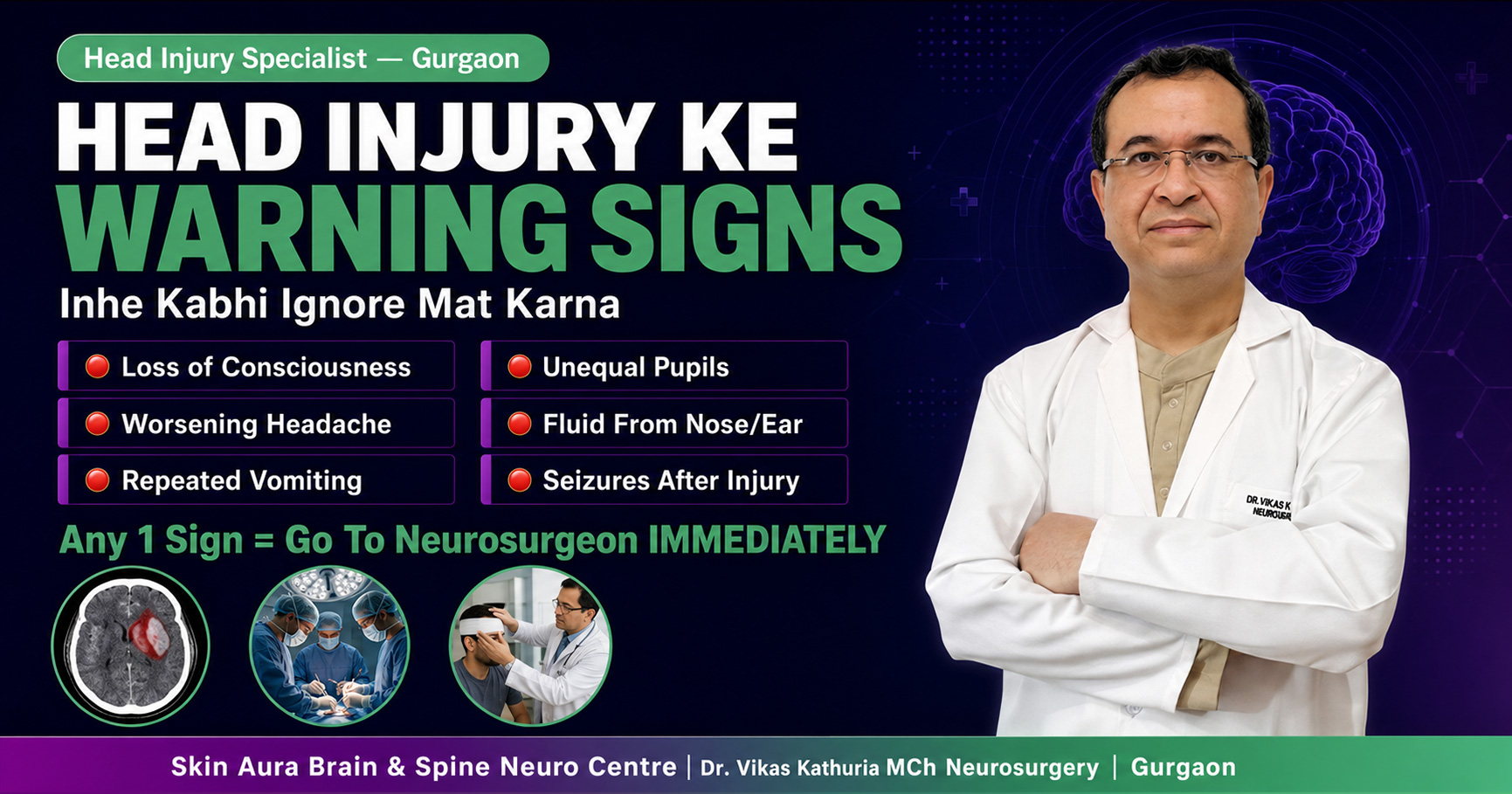
Not every head injury requires emergency hospital attendance. However, certain warning signs after any head impact demand immediate evaluation at a neurosurgical centre like Skin Aura Brain & Spine Neuro Centre Gurgaon. Seek emergency care immediately if there is loss of consciousness – even briefly, worsening headache that does not respond to simple pain relief, repeated vomiting after the injury, confusion, disorientation, or unusual behaviour, weakness or numbness developing in any limb, slurred speech or difficulty understanding language, seizures following the injury, clear fluid leaking from the nose or ears – a sign of basal skull fracture, unequal pupil sizes, or deteriorating level of consciousness at any point after the injury.
Do not observe a patient with these symptoms at home and wait to see if they improve. Traumatic intracranial haemorrhages can expand rapidly and are fatal when not treated promptly. The outcome of head injury treatment is directly determined by the speed of reaching specialist neurosurgical care.
Emergency neurosurgical treatment for head injuries at Skin Aura Brain & Spine Neuro Centre Gurgaon
Burr hole evacuation – For extradural and chronic subdural haematomas, a small burr hole is drilled in the skull and a drain is placed to remove the blood collection. This can often be performed under local anaesthesia in elderly or medically compromised patients, with rapid neurological recovery.
Craniotomy for haematoma evacuation – For large acute subdural or intracerebral haematomas causing significant brain compression, an open craniotomy is performed to rapidly evacuate the clot and achieve surgical haemostasis.
Decompressive craniectomy – For severe TBI with refractory raised intracranial pressure – pressure that does not respond to medical management – removing a large section of the skull provides the swelling brain with space to expand without fatal compression of the brainstem.
Depressed skull fracture repair – Surgically elevating depressed bone fragments to restore skull contour, prevent infection, and relieve underlying brain compression.
About Dr. Vikas Kathuria – head injury neurosurgeon at Skin Aura Brain & Spine Neuro Centre Gurgaon
Dr. Vikas Kathuria’s M.Ch. Neurosurgery qualification from one of India’s premier neurosurgical institutions and 14+ years of clinical experience include the full spectrum of traumatic brain injury management – from concussion assessment to emergency craniotomy. His membership in the Neurological Society of India (NSI) ensures his practice reflects current evidence-based TBI management guidelines. Patients from across Gurgaon, DLF, Golf Course Road, South Delhi, Faridabad, and NCR access his neurosurgical expertise at Skin Aura Brain & Spine Neuro Centre Gurgaon.
Rehabilitation after head injury
Neurosurgical treatment addresses the immediate life-threatening aspects of traumatic brain injury. Recovery of neurological function requires structured rehabilitation – physiotherapy for motor recovery, speech therapy for language and swallowing, occupational therapy for daily living skills, and neuropsychological support for cognitive and behavioural changes. Dr. Kathuria coordinates post-operative rehabilitation planning for all head injury patients at Skin Aura Brain & Spine Neuro Centre Gurgaon to maximise functional recovery.
Frequently asked questions
What should I do immediately after a head injury in Gurgaon?
Keep the person still and calm. Do not give food or water. Note the time of injury and any loss of consciousness. Proceed immediately to a neurosurgical facility if any warning signs are present. Contact Skin Aura Brain & Spine Neuro Centre Gurgaon for urgent specialist assessment.
Is every head injury serious?
No. Minor bumps without loss of consciousness, persistent headache, vomiting, or neurological symptoms can often be observed at home with clear written instructions. However, any uncertainty should prompt immediate specialist evaluation – it is always safer to be assessed and reassured than to wait.
How long does recovery from a head injury take?
Concussion typically resolves in 1–4 weeks with adequate rest. Moderate TBI recovery takes weeks to months. Severe TBI recovery is highly variable – some patients make remarkable recoveries while others are left with permanent deficits. Early neurosurgical intervention and intensive rehabilitation maximise the chances of the best possible outcome.
Can children get head injuries treated at Skin Aura Brain & Spine Neuro Centre Gurgaon?
Yes. Dr. Kathuria manages head injuries across all age groups including children and infants. Paediatric head injuries require specialist neurosurgical assessment as children’s presentations can differ significantly from adults.
What is the most important factor in head injury outcomes in Gurgaon?
Speed of reaching specialist neurosurgical care. The faster a traumatic intracranial haematoma is identified and surgically evacuated, the better the neurological outcome. Do not delay seeking care after a significant head injury.
Consult Dr. Vikas Kathuria for head injury treatment at Skin Aura Brain & Spine Neuro Centre Gurgaon
For emergency head injury assessment, urgent post-trauma consultation, or follow-up care after a traumatic brain injury, Dr. Vikas Kathuria at Skin Aura Brain & Spine Neuro Centre Gurgaon is available for specialist neurosurgical evaluation. Serving patients from DLF, Golf Course Road, South Delhi, Faridabad, Rewari, and across NCR. Do not delay – contact us today.