


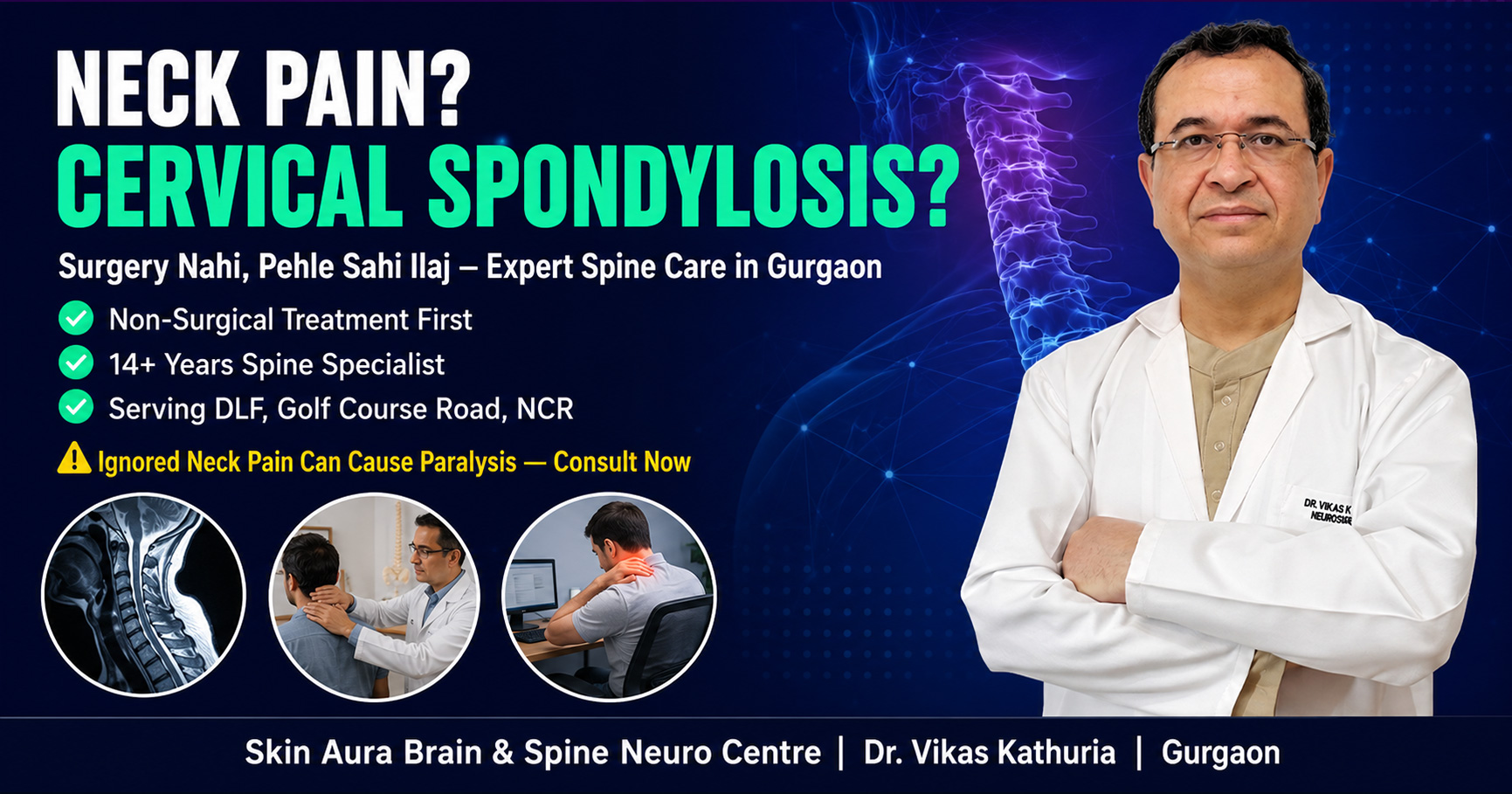
Best Treatment for Cervical Spondylosis in Gurgaon – A Complete Guide
Neck pain is one of the most common complaints among working adults in Gurgaon – and cervical spondylosis is one of its most frequent underlying causes. Whether you are a software engineer spending 10 hours a day at a desk in Cyber City, a professional commuting daily on Golf Course Road, or a homemaker in DLF carrying out repetitive daily tasks, the wear and tear that accumulates in the cervical spine over years eventually catches up with nearly everyone.
But when does cervical spondylosis become serious enough to require surgery? And when can it be managed effectively without an operation? This comprehensive guide from Dr. Vikas Kathuria at Skin Aura Brain & Spine Neuro Centre Gurgaon answers these questions clearly and honestly.
What is cervical spondylosis?
Cervical spondylosis is age-related degenerative change affecting the bones, discs, and joints of the cervical spine – the seven vertebrae in the neck. As the intervertebral discs between vertebrae lose water content and height with age, they bulge outward, bone spurs (osteophytes) form at vertebral edges, and the ligaments surrounding the spinal canal thicken and stiffen. These changes can narrow the spinal canal or the foramina through which nerve roots exit – compressing either the spinal cord itself (myelopathy) or individual nerve roots (radiculopathy).
Cervical spondylosis is extremely common – radiological evidence is present in over 90% of people above age 60. However, symptoms vary enormously – from mild neck stiffness to severe neurological disability – and the presence of imaging findings alone does not necessarily indicate a need for treatment.
Symptoms of cervical spondylosis
Neck pain and stiffness – often worse in the morning or after prolonged desk work – is the most common symptom. Patients at Skin Aura Brain & Spine Neuro Centre Gurgaon also frequently report headaches originating from the back of the neck, pain radiating into the shoulder and arm – sometimes extending to the hand and fingers, numbness or tingling in the arms or hands, weakness in the grip or arm muscles, and in more advanced cases, difficulty walking, loss of balance, and problems with fine motor tasks like writing or buttoning clothes – signs of cervical myelopathy that require urgent neurosurgical evaluation.
Non-surgical treatment for cervical spondylosis in Gurgaon
The vast majority of cervical spondylosis patients – including those with mild to moderate radiculopathy – are successfully managed without surgery. Dr. Vikas Kathuria at Skin Aura Brain & Spine Neuro Centre Gurgaon recommends a structured non-surgical treatment programme including physiotherapy focused on cervical strengthening, posture correction, and neck mobilisation exercises, pain management with anti-inflammatory medications and nerve-specific pain relief, cervical collar use during acute flare-ups to rest the neck, ergonomic workstation assessment and correction – critical for Gurgaon’s large desk-working population, epidural or foraminal steroid injections for patients with severe radiculopathy not responding adequately to oral medication, and lifestyle modification including activity pacing and sleep position adjustment.
Most patients with cervical radiculopathy improve significantly within 6–12 weeks of consistent conservative management. Complete resolution of symptoms is achieved in a large proportion of cases without any surgical intervention.
When is surgery needed for cervical spondylosis in Gurgaon?
Dr. Kathuria at Skin Aura Brain & Spine Neuro Centre Gurgaon recommends surgical intervention when cervical myelopathy is present – compression of the spinal cord causing walking difficulty, balance problems, hand clumsiness, or bladder dysfunction, progressive neurological deterioration despite adequate conservative treatment, severe radiculopathy with weakness or significant neurological deficit that is not improving, intractable pain that is severely impacting quality of life and has not responded to 6–12 weeks of appropriate conservative care, and significant spinal canal stenosis on imaging combined with progressive clinical symptoms.
The decision to recommend surgery is never taken lightly at Skin Aura Brain & Spine Neuro Centre Gurgaon. Dr. Kathuria reviews each patient’s MRI, clinical examination findings, and response to conservative treatment comprehensively before discussing surgical options.
Surgical options for cervical spondylosis at Skin Aura Brain & Spine Neuro Centre Gurgaon
Anterior cervical discectomy and fusion (ACDF)
Anterior cervical discectomy and fusion (ACDF) is the most commonly performed cervical spine surgery. The degenerated disc is removed through a small incision at the front of the neck, the nerve root or spinal cord is decompressed, and the vertebrae are stabilised with a cage and plate. Most patients experience significant improvement in arm pain and neurological symptoms within days of surgery.
Posterior cervical laminectomy
Posterior cervical laminectomy involves removing the lamina – the back wall of the spinal canal – to decompress the spinal cord from behind. This is used for multilevel cervical stenosis or myelopathy affecting multiple spinal levels.
Cervical disc replacement
Cervical disc replacement is an alternative to fusion for younger patients with single-level disc disease – a prosthetic disc replaces the degenerated one, preserving motion at that level and reducing the long-term risk of adjacent level degeneration.
About Dr. Vikas Kathuria – cervical spondylosis specialist at Skin Aura Brain & Spine Neuro Centre Gurgaon
Dr. Vikas Kathuria’s M.Ch. Neurosurgery qualification, 14+ years of experience managing cervical and lumbar spine conditions, and membership in the Neuro Spinal Surgeons Association (NSSA) make him one of Gurgaon’s most experienced neck pain and cervical spine specialists. His conservative-first philosophy ensures that every patient at Skin Aura Brain & Spine Neuro Centre Gurgaon receives the most appropriate treatment – surgical only when genuinely necessary.
Frequently asked questions
Can cervical spondylosis be cured without surgery?
For most patients, cervical spondylosis symptoms can be effectively managed with physiotherapy, medication, and lifestyle modification. Surgery is reserved for cases with neurological deficits or failure of conservative treatment.
Is cervical spondylosis common in young people in Gurgaon?
Increasingly yes. Poor posture from prolonged screen use, desk work, and smartphone use is accelerating cervical disc degeneration in people in their 30s and 40s – much earlier than the traditionally expected age of onset.
How long does recovery from cervical spine surgery take?
Most patients undergoing ACDF return to desk work within 2–4 weeks. Full recovery and return to all activities takes 6–12 weeks. Dr. Kathuria provides a detailed recovery timeline based on your specific procedure at Skin Aura Brain & Spine Neuro Centre Gurgaon.
Is neck surgery dangerous?
Cervical spine surgery carries risks including infection, bleeding, and nerve injury. However, when performed by an experienced M.Ch.-qualified neurosurgeon like Dr. Kathuria, the risks are low and the outcomes highly predictable for appropriate candidates.
Can I avoid surgery by changing my posture and lifestyle?
For mild to moderate cervical spondylosis, yes. Ergonomic correction, physiotherapy, and activity modification can significantly slow progression and manage symptoms. Dr. Kathuria counsels every patient on lifestyle measures as part of their treatment plan at Skin Aura Brain & Spine Neuro Centre Gurgaon.
Consult Dr. Vikas Kathuria for cervical spondylosis treatment at Skin Aura Brain & Spine Neuro Centre Gurgaon
Whether your neck pain needs physiotherapy, medication, or surgical evaluation, Dr. Vikas Kathuria at Skin Aura Brain & Spine Neuro Centre Gurgaon provides honest, expert assessment and the most appropriate treatment for your specific condition. Serving patients from DLF, Golf Course Road, South Delhi, Faridabad, and across NCR. Book your consultation today.