


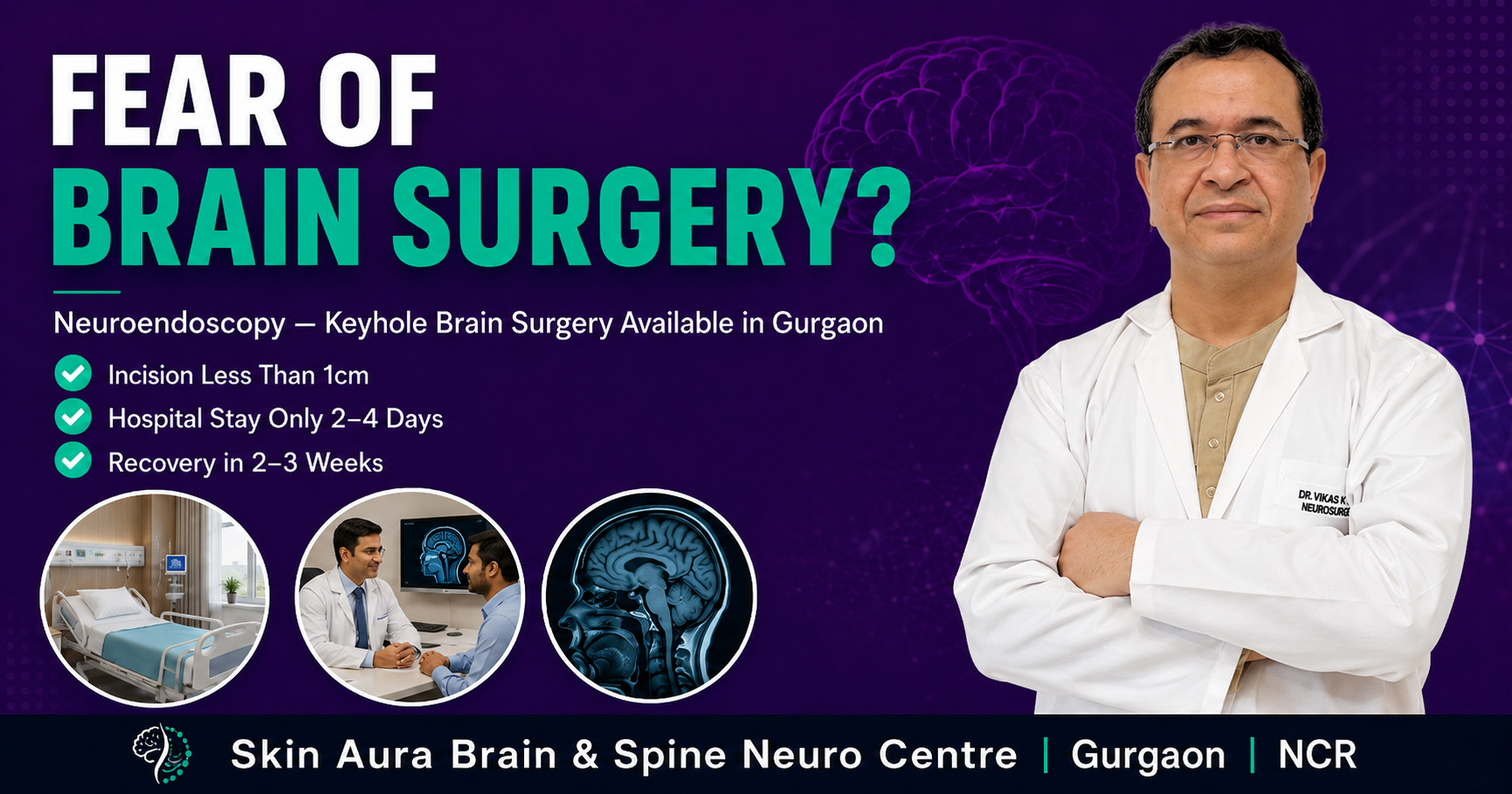
Neuroendoscopy in Gurgaon: The Modern Alternative to Traditional Brain Surgery
When most people think of brain surgery, they imagine a dramatic open operation involving a large incision, significant blood loss, weeks of recovery, and considerable risk. While open brain surgery remains necessary for many complex conditions, advances in neurosurgical technology have made it possible to treat a growing range of brain conditions through tiny keyhole incisions – with dramatically reduced trauma, shorter hospital stays, and faster recovery. This approach is called neuroendoscopy, and it represents one of the most significant advances in modern neurosurgery.
At Skin Aura Brain & Spine Neuro Centre Gurgaon, Dr. Vikas Kathuria is one of the very few neurosurgeons in Gurgaon with dedicated fellowship training in neuroendoscopy – giving patients across NCR access to this advanced minimally invasive brain surgery technique without travelling to a metro city.
What is neuroendoscopy?
Neuroendoscopy is a minimally invasive neurosurgical technique in which a thin, flexible or rigid endoscope – a narrow tube equipped with a camera and light source – is introduced into the brain or ventricular system through a small burr hole in the skull, typically less than 1 centimetre in diameter. The surgeon visualises the operating field on a high-definition monitor and performs the required procedure using miniaturised instruments passed through the working channel of the endoscope.
This approach eliminates the need for a large craniotomy – the traditional open skull opening – in many cases, significantly reducing surgical trauma, blood loss, infection risk, and recovery time. Patients at Skin Aura Brain & Spine Neuro Centre Gurgaon who are suitable candidates for neuroendoscopy benefit from all of these advantages compared to conventional open approaches.
What conditions can be treated with neuroendoscopy at Skin Aura Brain & Spine Neuro Centre Gurgaon?
Hydrocephalus – endoscopic third ventriculostomy (ETV)
Hydrocephalus is one of the most common indications for neuroendoscopy. In obstructive hydrocephalus – where CSF (cerebrospinal fluid) flow is blocked – an endoscope is used to create a small opening in the floor of the third ventricle, bypassing the obstruction and restoring normal CSF circulation. This procedure – ETV – eliminates the need for a VP shunt in suitable patients, avoiding the long-term complications associated with shunt hardware.
Intraventricular tumours
Tumours located within or adjacent to the brain’s ventricular system – such as colloid cysts, choroid plexus tumours, and certain intraventricular meningiomas – can often be safely removed through a neuroendoscopic approach, avoiding the brain retraction and tissue damage associated with open microsurgical access.
Colloid cysts
Colloid cysts of the third ventricle are benign but potentially life-threatening lesions that can suddenly obstruct CSF flow and cause rapid neurological deterioration. Neuroendoscopic removal of colloid cysts is now the preferred approach at Skin Aura Brain & Spine Neuro Centre Gurgaon – offering complete cyst removal through a small burr hole with minimal brain disruption.
Arachnoid cysts
Symptomatic arachnoid cysts – fluid-filled sacs within the brain – can be fenestrated (opened) endoscopically to decompress the surrounding brain tissue without requiring open craniotomy.
Endoscope-assisted microsurgery
In certain open procedures – including pituitary tumour surgery through the nose (endoscopic transsphenoidal surgery) and skull base procedures – the endoscope provides superior illumination and wider-angle visualisation compared to the traditional microscope, allowing more complete tumour removal with less surgical trauma.
How does neuroendoscopy compare to open brain surgery?
The advantages of neuroendoscopy over conventional open brain surgery are significant and well-established. The incision is dramatically smaller – a single burr hole less than 1cm versus a craniotomy of 5–10cm. Blood loss is minimal compared to open surgery. Hospital stay after neuroendoscopy is typically 2–4 days versus 5–10 days for open brain surgery. Recovery time is significantly shorter – most neuroendoscopy patients return to normal activities within 2–3 weeks. Risk of infection, bleeding, and brain retraction injury is substantially reduced. And postoperative pain is considerably less, improving patient comfort throughout recovery.
Not all brain conditions are suitable for neuroendoscopic treatment – patient selection is critical. Dr. Vikas Kathuria at Skin Aura Brain & Spine Neuro Centre Gurgaon carefully evaluates each patient’s imaging and clinical condition to determine whether a neuroendoscopic approach is appropriate and safe for their specific situation.
Dr. Vikas Kathuria – neuroendoscopy specialist at Skin Aura Brain & Spine Neuro Centre Gurgaon
Dr. Vikas Kathuria’s neuroendoscopy expertise sets him apart from the majority of neurosurgeons practising in Gurgaon and the wider NCR region. He completed a dedicated Neuroendoscopy Fellowship Programme at NSCB Govt. Medical College, Jabalpur in 2016 – one of India’s recognised centres for endoscopic neurosurgical training – in addition to his M.Ch. in Neurosurgery from V.S. Hospital, Smt. NHL Medical College, Ahmedabad. With 14+ years of neurosurgical experience and membership in the Neurological Society of India (NSI) and Neuro Spinal Surgeons Association (NSSA), Dr. Kathuria brings a rare combination of super-specialisation and subspecialty endoscopic expertise to every patient at Skin Aura Brain & Spine Neuro Centre Gurgaon.
What to expect: the neuroendoscopy procedure
Before surgery, detailed MRI and CT imaging is reviewed to plan the precise entry point and trajectory of the endoscope. On the day of surgery, general anaesthesia is administered. A small area of the scalp is shaved and a burr hole is made at the planned entry point. The endoscope is carefully introduced through the burr hole and navigated to the target area under continuous video guidance on a high-definition monitor. The required procedure – cyst fenestration, tumour removal, or ventriculostomy – is performed using instruments passed through the endoscope’s working channel. The endoscope is then withdrawn, the burr hole is covered, and the small scalp incision is closed with a few stitches. Most procedures take 1–2 hours.
Recovery after neuroendoscopy at Skin Aura Brain & Spine Neuro Centre Gurgaon
Most patients are alert and comfortable within hours of waking from anaesthesia. Hospital stay is typically 2–4 days. Headache and mild drowsiness in the first 24–48 hours are normal and managed with simple analgesia. Most patients are able to walk independently on the first post-operative day. Return to light activities occurs within 1–2 weeks, and full activity within 3–4 weeks for most procedures. Follow-up MRI at 4–6 weeks confirms the surgical outcome and guides further management planning.
Frequently asked questions
Is neuroendoscopy available in Gurgaon?
Yes. Dr. Vikas Kathuria at Skin Aura Brain & Spine Neuro Centre Gurgaon is one of the few neurosurgeons in Gurgaon with dedicated neuroendoscopy fellowship training – making advanced minimally invasive brain surgery accessible to patients across NCR without travelling to Delhi or other metro cities.
Is neuroendoscopy safe?
Yes – when performed by a trained neuroendoscopist. The risks of neuroendoscopy are significantly lower than those of open brain surgery for equivalent conditions. Dr. Kathuria’s dedicated fellowship training ensures the highest standard of endoscopic neurosurgical care at Skin Aura Brain & Spine Neuro Centre Gurgaon.
How do I know if I am a candidate for neuroendoscopy?
Suitability for neuroendoscopy depends on your specific diagnosis, the location and size of the lesion, and your overall health. Dr. Kathuria reviews each patient’s MRI and clinical status carefully before recommending any surgical approach at Skin Aura Brain & Spine Neuro Centre Gurgaon.
What is the cost of neuroendoscopy in Gurgaon?
Cost depends on the specific procedure, complexity, and duration of hospital stay. Dr. Kathuria provides transparent, itemised cost estimates during pre-operative consultation at Skin Aura Brain & Spine Neuro Centre Gurgaon – with no hidden charges.
Can neuroendoscopy replace all open brain surgeries?
No. Neuroendoscopy is appropriate for specific conditions and anatomical locations. For many brain tumours, vascular lesions, and trauma cases, open microsurgery remains the safest and most effective approach. The choice between neuroendoscopy and open surgery is made individually for every patient at Skin Aura Brain & Spine Neuro Centre Gurgaon.
Book your neuroendoscopy consultation at Skin Aura Brain & Spine Neuro Centre Gurgaon
If you or a family member has been diagnosed with hydrocephalus, a brain cyst, an intraventricular tumour, or any condition that may be treatable with minimally invasive brain surgery, book a consultation with Dr. Vikas Kathuria at Skin Aura Brain & Spine Neuro Centre Gurgaon today. Serving patients from DLF, Golf Course Road, South Delhi, Faridabad, and across NCR.